Two Ancestral Lives, the Salem Witch Trials, and the Enduring Legacy of Conscience
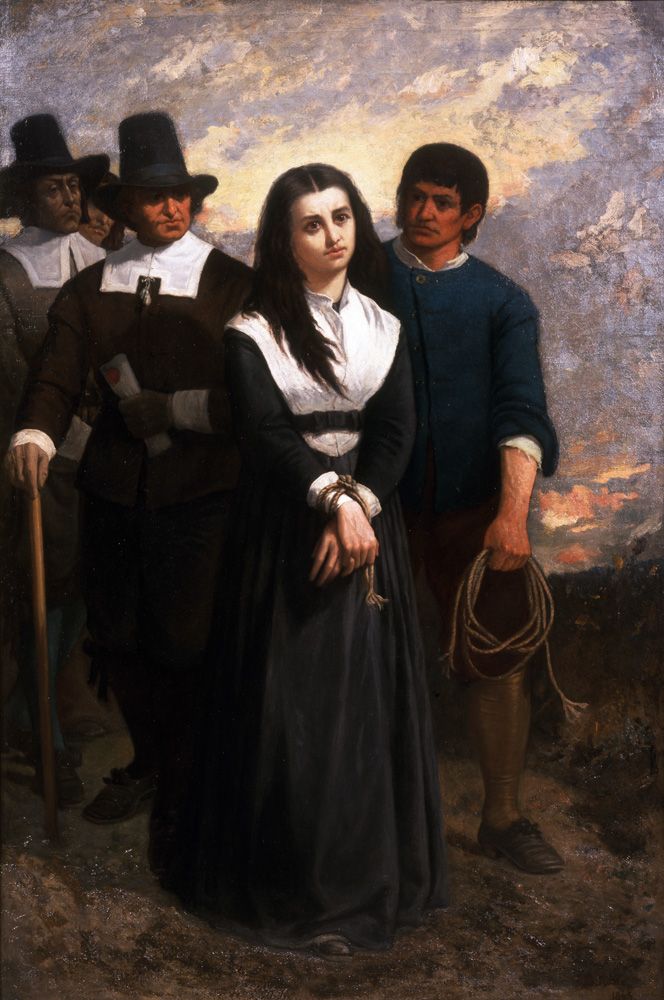
Witch Hill (The Salem Martyr) by Thomas Satterwhite Noble, 1869. Oil on canvas. Collection of the New York Historical Society.
Poised between innocence and execution, a young woman awaits her fate in this haunting portrayal of the Salem witch trials of 1692. With extraordinary sensitivity, American artist Thomas Satterwhite Noble captures the terrible vulnerability of an individual condemned by a society in which religious fanaticism, superstition, and judicial authority had become tragically intertwined.
For the figure of the condemned woman, Noble reportedly selected a young librarian employed by the Cincinnati Public Library. According to family tradition, she was a direct descendant of a woman executed for witchcraft in seventeenth-century Salem—a poignant ancestral connection that lends the painting an additional dimension of historical remembrance.
Already celebrated for his dramatic paintings confronting the moral injustices of slavery, Noble turned his artistic conscience toward another dark chapter of American history. His Salem Martyr earned a silver medal at the Cincinnati Industrial Exposition of 1869.
October arrives dressed in enchantment.
Witches soar across harvest moons, jack-o’-lanterns illuminate autumn evenings, and black cats keep mysterious company with bubbling cauldrons and crooked broomsticks. We delight in the theatrical mischief of Halloween, celebrating creatures and superstitions that have long inhabited humanity’s imagination. Yet beneath the whimsical imagery of pointed hats and magical incantations lies a history considerably darker than any seasonal ghost story.
In 1692, the Massachusetts Bay Colony descended into one of the darkest chapters of its history. Twenty innocent people were put to death, while nearly two hundred others were accused of witchcraft and imprisoned, many languishing for months in overcrowded, squalid, and often merciless conditions. Some would never emerge alive, succumbing to illness and the hardships of confinement before their innocence could be vindicated.
What began as a series of accusations in Salem Village soon spread far beyond its borders, engulfing communities throughout the colony in a fever of religious dread, suspicion, and collective hysteria. Neighbors turned against neighbors, longstanding reputations crumbled beneath the weight of unsubstantiated allegations, and the ordinary safeguards of justice yielded to the terrifying conviction that Satan walked among them.
By the time the persecutions subsided, the tragedy had revealed a devastating truth: when fear is mistaken for evidence and moral certainty replaces reason, even a society devoted to righteousness can become the instrument of extraordinary cruelty.
For my tenth great-grandmother, Mary Towne Easty, being called a witch was neither fanciful nor amusing.
It was a death sentence.
On September 22, 1692, Mary Towne Easty was hanged in Salem, Massachusetts, convicted of a supernatural crime she had not committed. She was approximately fifty-eight years old, a wife, a mother, and a woman whose decades of Christian devotion and respectable conduct could not protect her from the accusations of her neighbors.
Her story would be compelling enough as an account of innocence destroyed by religious fanaticism and judicial injustice. But my family’s connection to Salem possesses an additional, deeply unsettling dimension.
My husband’s eighth great-grandmother, Sarah Vibber, also known as Sarah Bibber, was one of the women whose sworn accusations helped sustain the prosecutions—including those against Mary Towne Easty and her sister Rebecca Nurse.
Thus, through the extraordinary convergence of two ancestral lines, my husband and I are connected to opposing sides of one of the most infamous episodes in American colonial history.
One ancestor stood accused.
The other participated in the accusations.
Their histories illuminate not only the devastating consequences of superstition, but the perilous intersection of misogyny, religious authority, personal grievances, and the human capacity to mistake conviction for truth.
And their stories invite a question that remains as urgent today as it was in 1692:
What happens when a society becomes so certain of its righteousness that it loses the ability to recognize injustice?
I. Between Two Worlds: From Great Yarmouth to Massachusetts Bay
Mary Towne was baptized on August 24, 1634, at the Church of St. Nicholas in Great Yarmouth, Norfolk, England, the daughter of William Towne and Joanna Blessing Towne.

The Minster Church of St. Nicholas — Great Yarmouth, Norfolk, England
Rising majestically above the rooftops of Great Yarmouth, the Minster Church of St. Nicholas has watched over this historic North Sea port for more than nine centuries. Founded in 1101, it is England’s largest parish church and the sacred place where Mary Towne Easty was baptized on August 24, 1634.
Devastated by wartime bombing in 1942 and subsequently restored, its soaring Gothic architecture and venerable Norman tower stand as magnificent testaments to resilience, architectural splendor, and the enduring passage of centuries.
During her childhood, the family crossed the Atlantic and settled in the Massachusetts Bay Colony, eventually establishing themselves in Topsfield. The contrast between the world they left behind and the one they entered must have been extraordinary.
Great Yarmouth was an established maritime center; its harbor was crowded with fishing vessels and merchant ships navigating the turbulent North Sea. Situated at the mouth of the River Yare, it served as a gateway to Norwich, one of medieval England’s foremost centers of woolen manufacture and commerce. The immense Church of St. Nicholas testified to the town’s historical prosperity, while the surrounding Norfolk countryside unfolded across broad expanses of marshland, cultivated fields, waterways, and windmills.
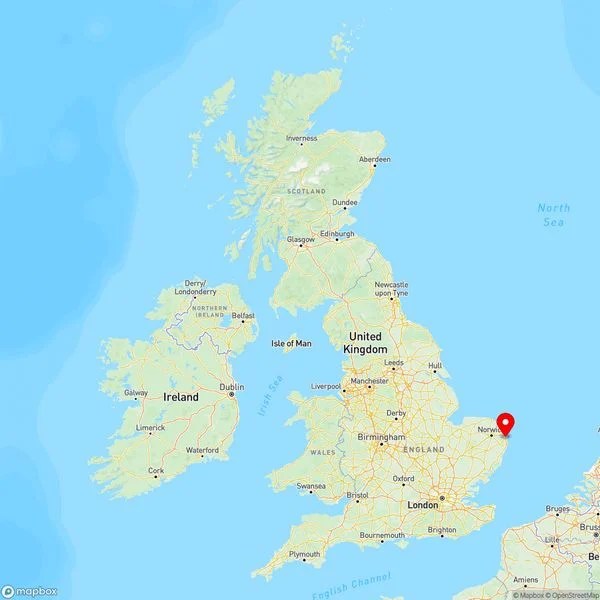
Location of Great Yarmouth — Norfolk, East Anglia, England
Situated on England’s eastern coast in the historic county of Norfolk, Great Yarmouth rests along the North Sea, approximately 20 miles east of Norwich and 115 miles northeast of London.
Nestled between the River Yare and the sea, this venerable maritime town has flourished for centuries as a center of fishing, commerce, and coastal trade. Its distinctive geographical position places it at the eastern edge of East Anglia, where the landscapes of rural Norfolk meet the restless waters of the North Sea.

Great Yarmouth — Norfolk, England
Bathed in the gentle glow of afternoon sunlight, Great Yarmouth’s historic waterfront stretches gracefully along the River Yare, its handsome architecture reflected in the tranquil waters below.
Once among England’s most prosperous fishing ports, this venerable coastal town has been shaped by centuries of maritime commerce, seafaring traditions, and the enduring rhythms of the North Sea.
Today, its picturesque quayside offers a captivating portrait of past and present, where the architectural echoes of bygone generations mingle with the quiet vitality of modern life.
Salem presented a strikingly different prospect.
Its modest collection of timber dwellings occupied a rugged peninsula along the Massachusetts coast. Beyond the settlement stretched dense forests, rocky terrain, unfamiliar wildlife, and a landscape whose seasonal rhythms the newcomers had scarcely begun to comprehend. Yet this country was neither empty nor uninhabited. Indigenous peoples had cultivated, traversed, and understood the region for generations, maintaining established networks of settlements, trails, waterways, and trading places. What appeared to English immigrants as forbidding wilderness was already an ancestral homeland.
For the Townes, the Atlantic crossing represented both uncertainty and opportunity: the possibility of acquiring land, establishing a livelihood, and participating in a religious community shaped by their convictions. Their migration formed part of the broader Puritan movement, whose adherents sought to reform Christianity according to what they understood as the original teachings of Scripture.
The term Puritan had initially been employed as an insult. Many members of the movement instead regarded themselves as God’s faithful people, engaged in the sacred work of restoring the church to its proper spiritual condition.
Their determination was formidable.
They challenged powerful religious institutions, disputed the authority of the English monarchy in matters of worship, and endured persecution for convictions they believed were divinely ordained. Yet their migration was motivated by more than theology. Economic instability, competition for land, and the prospect of greater independence also encouraged English families to seek new lives across the Atlantic.
The founders of Massachusetts Bay envisioned an exemplary Christian commonwealth, a society whose institutions and inhabitants would reflect their understanding of divine law. Religion permeated nearly every aspect of colonial existence, governing family relationships, education, civic responsibilities, and acceptable public conduct. But this experiment in godly living contained a profound contradiction.
The settlers who sought freedom from religious oppression established a society capable of imposing its own severe restrictions upon dissent and individual conscience. And despite the revolutionary character of some Puritan aspirations, the social order they constructed remained unmistakably patriarchal.
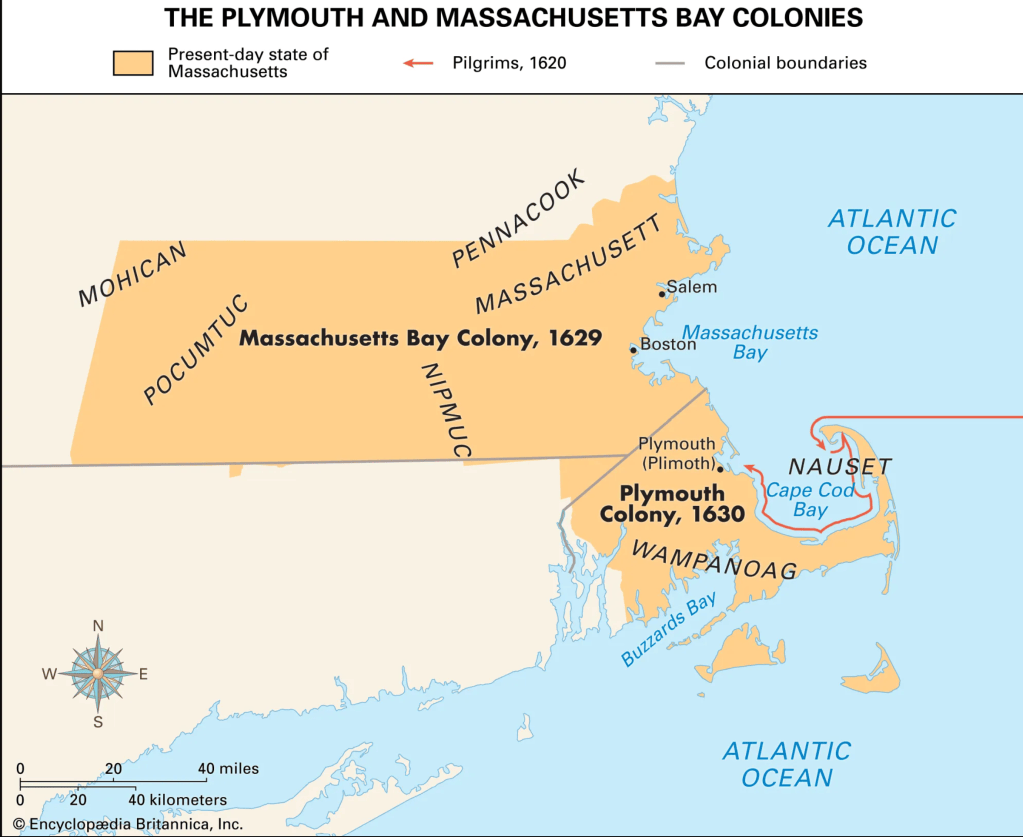
The Plymouth and Massachusetts Bay Colonies — Seventeenth-Century New England
This historical map illustrates the early English colonies of Plymouth, established in 1620, and Massachusetts Bay, chartered in 1629, along the Atlantic coast of present-day Massachusetts.
It also identifies the ancestral territories of Indigenous peoples, including the Wampanoag, Massachusett, and Nauset, whose histories long preceded European settlement.
Among the coastal communities marked is Salem, where Puritan religious convictions, colonial authority, and deeply rooted fears would converge in the witch trials of 1692.
II. A Woman’s Place: Faith, Authority, and the Burden of Obedience
In seventeenth-century Massachusetts, political power, ecclesiastical authority, and most formal legal institutions rested overwhelmingly in male hands. Husbands governed households. Ministers interpreted religious doctrine. Magistrates exercised the authority to investigate, prosecute, and punish.
Women performed indispensable labor, raised families, sustained households, and participated actively in religious life. Yet their opportunities to exercise independent public authority were sharply constrained. English common-law traditions generally limited the separate legal and economic identity of married women, while prevailing religious interpretations emphasized their obligation to submit to male authority.
Certain readings of Eve’s transgression in the Garden of Eden reinforced the belief that women were particularly vulnerable to temptation and spiritual deception. Centuries of European writings on witchcraft had cultivated the suspicion that women were especially susceptible to Satan’s influence.
Thus, a cruel paradox emerged.
Women were expected to exemplify Christian virtue while simultaneously being regarded as potential instruments of evil. They were entrusted with immense moral responsibilities but denied equal authority in the institutions that judged their conduct.
Around 1655, Mary Towne married Isaac Easty, a farmer and cooper, and together they established a substantial household in Topsfield, raising a large family. For decades, Mary Towne Easty fulfilled the responsibilities prescribed for respectable colonial womanhood. She practiced her faith, nurtured her children, and maintained her place within the community.
Yet the persecution that eventually consumed her family revealed a devastating truth about patriarchal societies:
A woman could satisfy nearly every expectation imposed upon her and still discover that obedience offered no protection against prejudice.
Mary’s mother, Joanna Blessing Towne, had already encountered the dangers of community suspicion. In 1670, Joanna became involved in a dispute concerning the Reverend Thomas Gilbert, a Topsfield minister accused of excessive drinking. By defending him, she placed herself at odds with members of the influential Gould family. Later accounts suggest that this controversy contributed to rumors portraying Joanna as a witch, although the precise origins of those suspicions remain uncertain.
The episode illustrates how an outspoken widow could become vulnerable to damaging accusations, particularly when her opinions challenged influential neighbors. Such suspicions could linger long after the original dispute had faded. When three of Joanna’s daughters were accused of witchcraft in 1692, their family relationships became entangled with allegations of inherited wickedness. The accusations against the Towne women reveal how readily ordinary disagreements, longstanding resentments, and gendered assumptions could acquire supernatural significance.
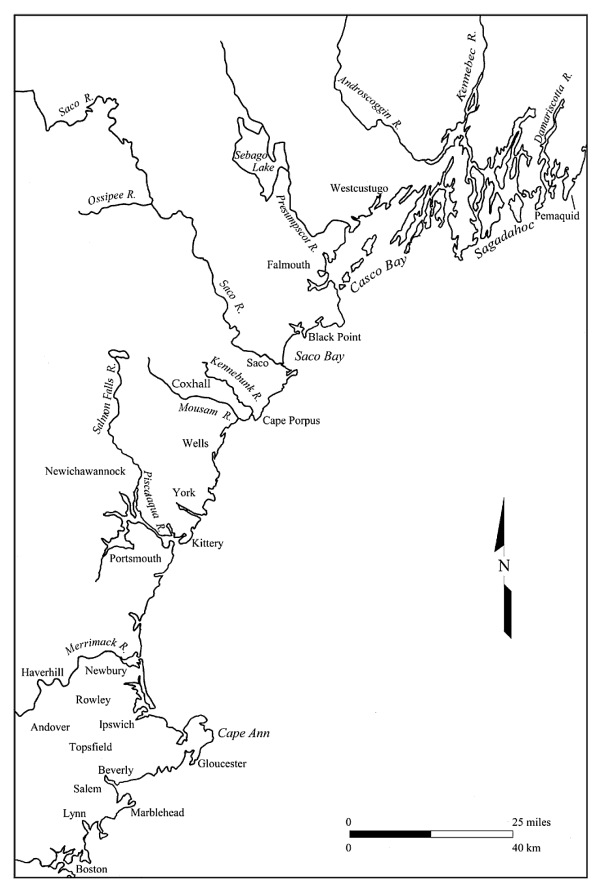
Colonial Settlements of Massachusetts Bay and Northern New England — Map by Emerson W. Baker
This historical map traces the settlements and waterways of seventeenth-century New England, highlighting Topsfield, Massachusetts, a rural Puritan community northwest of Salem.
Here, Mary Towne Easty and her husband, Isaac, established their home and raised their family amid the farms and woodlands of colonial Essex County. Situated near Ipswich, Beverly, and Salem, Topsfield was part of a closely connected world of faith, agriculture, and community life.
III. Salem, 1692: When Fear Became Law
By early 1692, Salem Village was burdened by religious tensions, political uncertainty, longstanding disputes, and an intensely held belief in the reality of Satan’s interference in human affairs. When several young people began experiencing disturbing fits and claimed to be tormented by invisible forces, some neighbors and authorities interpreted their suffering as evidence of witchcraft. Accusations multiplied with alarming speed.
The resulting prosecutions were not merely spontaneous expressions of collective panic. They proceeded through established institutions of government. Magistrates conducted examinations. Witnesses presented testimony. Juries returned verdicts. Judges pronounced sentences. The machinery of law bestowed an appearance of legitimacy upon proceedings that repeatedly failed to distinguish credible evidence from extraordinary allegations. Particularly destructive was the admission of spectral evidence: testimony claiming that an accused person’s apparition had appeared and inflicted supernatural harm.
Under such reasoning, physical absence offered no defense.
A woman could be confined within a prison cell while her accusers insisted that her invisible spirit was attacking them elsewhere. Denial could be interpreted as deception. Religious devotion could be dismissed as a disguise for wickedness. Ordinary misfortune could be attributed to malevolent enchantment. The accused were effectively required to disprove events that could not be independently verified.
And for women living under a social order that granted religious and judicial authority predominantly to men, challenging the accusations also meant confronting institutions they had been taught to obey.
IV. Three Sisters Accused: The Persecution of the Towne Women
Among the families devastated by the Salem trials, the Towne sisters occupy a particularly poignant place. Rebecca Nurse, Mary Easty, and Sarah Cloyce were all accused of witchcraft.
Two would be executed.
Only Sarah survived.
Rebecca, the eldest, was arrested in March 1692. Despite her reputation as a respected elderly church member, she was prosecuted on accusations of supernatural wrongdoing. Her trial exposed the profound deterioration of judicial fairness. A jury initially returned a verdict of not guilty, but reconsidered after the judges challenged its decision. Rebecca Nurse was subsequently condemned and hung on July 19, 1692.
Sarah Cloyce also faced accusations, while Mary was arrested on April 21 and examined the following day by magistrates John Hathorne and Jonathan Corwin. The surviving record preserves a remarkable confrontation.
When questioned about her guilt, Mary declared:
“I can say before Christ Jesus, I am free.”
Pressed to explain the supposed suffering of her accusers, she answered:
“I know nothing.”
When the magistrates continued demanding explanations consistent with their assumptions, Mary challenged the injustice directly:
“Would you have me accuse myself?”
And later:
“Well Sir would you have me confess that I never knew?”
Her words possess an extraordinary simplicity.
She was being asked to acknowledge a crime she had not committed and explain supernatural events of which she knew nothing.
She refused.
Mary’s resistance arose from her deeply held Christian convictions. She believed that falsely confessing would violate her conscience before God. She was not advancing a modern feminist philosophy. Yet her refusal carries profound significance when examined through the history of women’s struggles against coercive authority.
Her fidelity to conscience became an act of resistance against the men who claimed the power to determine her fate.
On May 18, after nearly a month of imprisonment, Mary was released.
Her freedom lasted approximately two days.
Renewed allegations of spectral torment led to her rearrest, and she returned to confinement while her husband and children endured the uncertainty of her approaching trial. Mary and Sarah Cloyce sought greater fairness through a joint petition, requesting opportunities to present reputable witnesses and challenge the evidence against them. Their appeals reveal women who understood that the judicial process itself had become a source of danger.
Yet the machinery of prosecution continued.
And among those supplying accusations was a woman whose descendants would eventually become part of my own family.
V. Sarah Vibber: An Accuser Within the Family’s History
Among the many unsettling dimensions of the Salem witch trials, few are as personally extraordinary as the discovery that my husband’s eighth great-grandmother, Sarah Vibber, was among the accusers whose testimony helped sustain the persecution of my own tenth great-grandmother, Mary Towne Easty.
Sarah, whose surname frequently appears as Bibber in surviving colonial records, was reportedly born around 1656 in St. Ouen, on the island of Jersey in the English Channel. Sarah and her husband, Jean Vibert—whose name was anglicized as John Vibber—immigrated to New England before 1685.
By the summer of 1692, Sarah was approximately thirty-six years old and had emerged as a prominent adult participant in the escalating witchcraft accusations. Unlike the adolescent girls whose mysterious afflictions had helped ignite the crisis, she was a married woman with an established household and a reputation that some of her neighbors openly disputed. Her involvement extended beyond the dramatic displays of alleged supernatural torment that characterized the proceedings. Sarah appeared in surviving court documents, supplied sworn depositions, and participated in accusations involving numerous individuals suspected of witchcraft. Her testimony frequently relied upon spectral evidence: the assertion that an accused person’s invisible apparition could assault the living, inflict excruciating pain, and provoke violent convulsions, even while the accused remained physically elsewhere.
Such allegations presented an almost insurmountable obstacle to any meaningful defense. How could an innocent person establish an alibi against the supposed movements of an invisible spirit? How could a court distinguish supernatural assault from illness, emotional distress, deception, or misunderstanding when the alleged phenomenon itself could not be independently observed?
Yet in Salem’s atmosphere of religious dread and mounting suspicion, these unverifiable claims acquired extraordinary judicial significance. The court’s willingness to treat spectral allegations as evidence transformed private fears and personal accusations into instruments of potentially lethal authority.
Sarah’s name appears in records associated with accusations against fifteen individuals, whose eventual fates illustrate the terrible reach of the prosecutions:
- Mary Bradbury: Convicted but escaped execution.
- George Burroughs: Executed by hanging.
- Giles Corey: Pressed to death after refusing to enter a plea.
- Mary Towne Easty: Convicted and executed by hanging.
- Sarah Good: Executed by hanging.
- Dorcas Hoar: Convicted but spared execution.
- Elizabeth Howe: Executed by hanging.
- George Jacobs Sr.: Executed by hanging.
- Susannah Martin: Executed by hanging.
- Rebecca Nurse: Convicted and executed by hanging.
- Alice Parker: Executed by hanging.
- John Proctor: Executed by hanging.
- Ann Pudeator: Executed by hanging.
- Job Tookey: Released.
- John Willard: Executed by hanging.
Of these fifteen individuals, eleven were hanged, one—Giles Corey—was pressed to death, and three escaped executions. Although Sarah’s precise evidentiary role varied among the proceedings, her involvement places her within the network of accusations that contributed to the Salem tragedy. It would be historically inaccurate, however, to attribute every conviction or execution directly to her testimony alone.
For me, two names on this list carry an especially profound significance: Mary Towne Easty and Rebecca Nurse, my tenth great-grandmother and her sister. The historical record thus places my husband’s ancestor among those accusing members of my own ancestral family of crimes that existed only within the supernatural assumptions of their age.
The contrast between Mary and Sarah is particularly revealing.
Mary, approaching sixty, had spent decades cultivating a reputation for Christian devotion, gentleness, and respectable conduct within her community. Sarah, meanwhile, faced pointed criticism from neighbors who questioned her honesty, temperament, and credibility. These criticisms must themselves be approached with historical caution. The allegations against Sarah may have reflected genuine observations, personal animosities, or the same restrictive expectations of female behavior that shaped the wider society. They do not conclusively establish that she knowingly fabricated her accounts of affliction.
Nevertheless, the existence of such testimony demonstrates that doubts about Sarah’s reliability were neither imaginary nor confined to later historical interpretation.
Some of her contemporaries openly challenged her claims. Yet the courts continued to entertain her accusations. The consequences became especially grave in Mary’s case.
On August 3, 1692, Sarah submitted sworn testimony alleging that she had witnessed Mary’s spectral apparition hovering over the bed of an ill man named John Norton. According to Sarah’s account, the apparition suddenly flew toward her and inflicted supernatural suffering. She further alleged that Mary’s specter had tormented several other afflicted individuals, including Mercy Lewis, Mary Walcott, Ann Putnam Jr., and Elizabeth Hubbard. The deposition reveals the disturbing elasticity of spectral evidence.
A sick man’s bedside became the setting for an alleged supernatural visitation. Sarah’s reported suffering was attributed to the apparition of a woman already imprisoned. The supposed afflictions of several other individuals were gathered into a narrative portraying Mary as an active and continuing danger to the community.
What should have remained an unverified allegation was presented as evidence of diabolical activity.
Sarah’s deposition formed only one part of the proceedings against Mary, and the surviving records do not establish that it independently determined the verdict. Nevertheless, it contributed to the accusations through which an innocent woman was prosecuted and ultimately condemned.
There is a profound historical irony in the relationship between these two women.
Both inhabited a society that restricted female independence and vested ultimate religious and judicial authority predominantly in men. Yet within that unequal system, Sarah’s claims of supernatural victimization acquired influence, while Mary’s insistence upon her innocence failed to secure her protection.
One woman’s testimony was granted credibility despite serious questions about its reliability; another woman’s decades of respectable conduct could not outweigh accusations that defied ordinary standards of proof.
Their opposing experiences illuminate a particularly troubling truth: patriarchal institutions do not invariably silence every woman. They may selectively elevate certain female voices when those voices reinforce the assumptions and objectives of established authority, even while denying justice to others.
Sarah’s personal motives remain beyond our certain knowledge. Whether she sincerely believed herself afflicted, misunderstood her experiences, yielded to communal pressure, or consciously deceived the authorities cannot be conclusively determined from the surviving documents. But the central failure of Salem did not depend upon establishing the private intentions of every accuser. It lay in the willingness of magistrates and judges to accept allegations of invisible wrongdoing as grounds for depriving human beings of their liberty, reputations, and lives.
And therein lies the most haunting dimension of this ancestral connection.
More than three centuries later, the descendants of Mary Easty and Sarah Vibber would become members of the same family through marriage—uniting two lineages whose forebears had occupied opposing positions in a judicial catastrophe. The passage of generations has not erased the moral significance of their encounter.
Rather, it has brought that history into unexpectedly intimate focus, reminding me that the past is rarely populated by uncomplicated heroes and villains, and that family ancestry can encompass both those who suffered injustice and those who participated in its perpetuation.
The court received accusations of supernatural activity. It did not possess reliable proof that Mary Towne Easty had committed a crime.
And in that fatal confusion between allegation and evidence lies one of the most enduring lessons of Salem: justice cannot survive when the certainty of an accusation is permitted to substitute for the burden of proving it.
VI. The Witness Whose Credibility Was Challenged
Sarah Vibber’s testimony becomes especially troubling when considered alongside the statements of neighbors who openly questioned her conduct. During proceedings involving Rebecca Nurse in June 1692, several witnesses challenged Sarah’s credibility.
John and Lydia Porter described her as turbulent and quarrelsome, alleging that she frequently argued with her husband and experienced strange fits when circumstances displeased her. Joseph Fowler similarly characterized her as idle, contentious, and inclined toward malicious gossip. Thomas and Mary Jacobs accused her of falsehoods, obscene language, and expressions of hostility toward her children. Richard Walker also testified that he had observed Sarah experiencing unusual fits when frustrated. These statements were themselves allegations and may have reflected personal animosities or the gendered expectations of the period. They cannot be accepted uncritically as definitive judgments of Sarah’s character.
Their historical importance lies in demonstrating that skepticism about the afflicted witnesses existed within the community even as the prosecutions continued.
One particularly revealing account came from Sarah Nurse, Rebecca’s daughter. She testified that she had observed Sarah Bibber removing pins from her clothing and holding them between her fingers before crying out that Rebecca’s apparition had pricked her. If this observation was accurate, it suggested a natural explanation for an injury presented as supernatural.
The courts nevertheless continued to entertain spectral accusations.
The community was far from unanimous in its convictions. Amid the mounting hysteria, courageous individuals questioned the credibility of the afflicted, defended the reputations of the accused, and challenged the glaring injustices unfolding before them. Yet their objections proved tragically insufficient to halt the executions. Worse still, to speak against the proceedings was to risk becoming ensnared in them as well. Those who dared question the accusers or challenge the authority of the courts exposed themselves to suspicion, hostility, and the terrifying possibility of being accused of witchcraft in turn. In Salem, defending the innocent could itself become an act of extraordinary personal peril, for when fear acquires the authority of law, even the courage to speak the truth may be mistaken for evidence of guilt.
Sarah’s role also reveals a complicated dimension of the trials’ gender politics.
Although women generally possessed limited institutional authority, certain female accusers acquired considerable influence when their claims were endorsed by male magistrates and ministers. The same patriarchal system that constrained Sarah’s independence could amplify her testimony while denying adequate protection to another woman. The tragedy was therefore not simply one of men persecuting women. It was a broader failure of justice in which women could become both victims and participants, while the institutions possessing ultimate authority remained overwhelmingly male.
The decisive question was not whether Sarah was personally virtuous or wicked. It was why allegations so extraordinary, disputed, and incapable of independent verification were permitted to determine the fate of another human being.
VII. The Most Extraordinary Act of Courage: A Condemned Woman Pleads for Others
On September 9, 1692, Mary Towne Easty was convicted of witchcraft and sentenced to death. Her sister Rebecca had already been executed, and Mary understood the fate awaiting her. Yet the petition she submitted following her conviction remains among the most remarkable documents of the Salem tragedy. Rather than devote her final appeal to securing her own release, she implored the authorities to reconsider their methods and prevent further innocent deaths.
Her words were profoundly moving:
“I petition to your honours not for my own life for I know I must die and my appointed time is set…”
She then revealed the purpose of her appeal:
“…if it be possible no more innocent blood may be shed…”
Mary urged the magistrates to examine accusations more carefully, question witnesses separately, and scrutinize the confessions of those who claimed to have practiced witchcraft. The relevance of this appeal becomes especially poignant when considered alongside Sarah Vibber’s testimony.
Mary was asking the court to investigate precisely the kinds of allegations that had been used against her: claims of invisible assaults, mysterious afflictions, and supernatural encounters that could not be reliably corroborated. Her petition did not identify Sarah as the singular cause of her condemnation, nor can we know whether Mary had her specifically in mind. But the surviving record illustrates why her concerns were so urgent. Witnesses had challenged Sarah’s credibility. Yet spectral testimony continued to carry weight. Mary understood the danger of a system unwilling to distinguish between accusation and proof.
Consider the extraordinary moral generosity of her response.
Her liberty had been taken, her reputation assaulted, her family devastated, and her death pronounced inevitable. Nevertheless, standing at the threshold of eternity, she directed her remaining strength toward the preservation of lives other than her own. The contrast between the condemned woman and her judges is devastating.
The magistrates possessed the authority to determine who would live and who would die.
Mary possessed the wisdom to recognize that the preservation of innocent life mattered more than the preservation of institutional authority. She did not merely proclaim her innocence. She challenged the moral legitimacy of a judicial process that had confused accusation with evidence and certainty with truth.
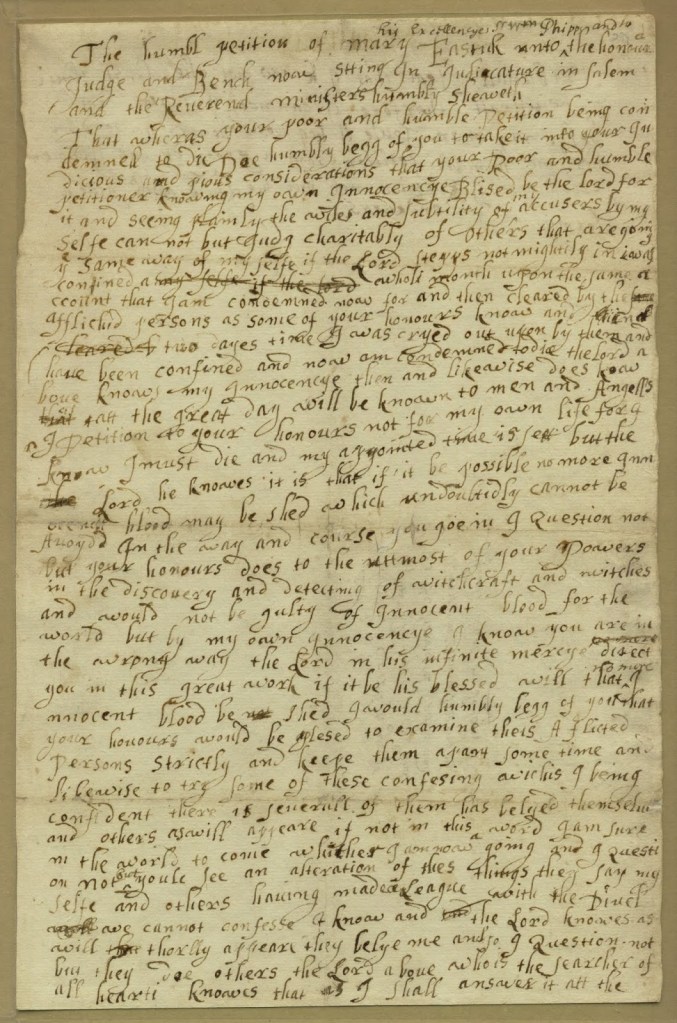
The Final Petition of Mary Towne Easty — Salem, Massachusetts, September 1692
These remarkable surviving pages preserve the words of Mary Towne Easty, written after her conviction for witchcraft and shortly before her execution on September 22, 1692.
More than three centuries later, her petition addressing the magistrates and ministers of Salem remains a profoundly moving testament to conscience, humanity, and the quiet eloquence of a woman who, facing death, sought justice for others.
VIII. September 22, 1692: The Final Farewell
On September 22, 1692, Mary Towne Easty was taken to the execution site now identified as Proctor’s Ledge in Salem.
Seven others were hanged alongside her, becoming the final eight victims executed by hanging during the Salem witch trials.
Mary’s farewell to her husband, children, and friends was remembered as an exceptionally poignant scene. Robert Calef later recorded that those present described her parting as solemn, affectionate, and deeply religious, moving nearly everyone who witnessed it to tears. We cannot know her final private thoughts, nor can we fully comprehend the sorrow of a woman preparing to leave behind the family she had nurtured for decades. But the surviving records reveal the dignity with which she faced her ordeal.
At approximately fifty-eight years of age, Mary was executed for a supernatural offense that existed only in the beliefs and accusations of those who condemned her. There had been no demonstrated pact with Satan, no credible evidence of diabolical conspiracy, and no reliable proof that she had inflicted the injuries attributed to her. There was an innocent woman, a court that condemned her, and a community whose anxieties had acquired the terrible force of law.
Her death was irreversible.
The Massachusetts authorities had extinguished a life, shattered a family, and committed an injustice that would haunt the historical conscience of New England for centuries. Yet the testimony of Mary’s character endured in the very documents produced by the institutions that condemned her. The courts preserved her words.
History would eventually recognize their significance.
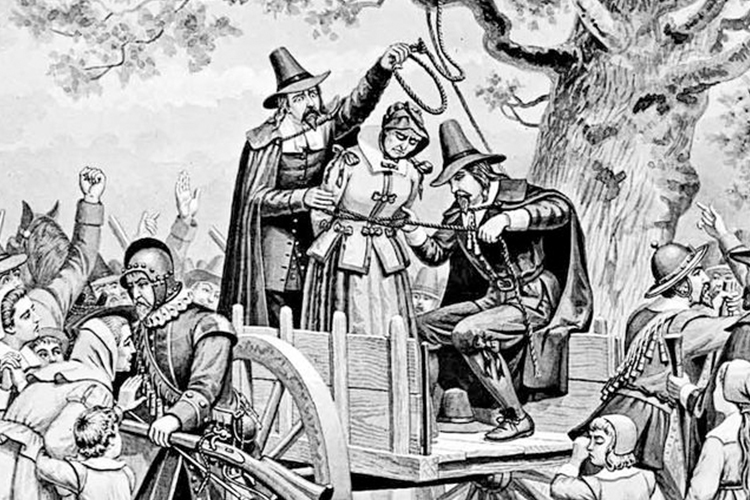
The Execution of Bridget Bishop at Salem, 1692 — Illustration by Joseph Boggs Beale, c. 1885
This haunting illustration depicts the execution of Bridget Bishop, the first person hanged during the Salem witch trials, on June 10, 1692. Her death foreshadowed the fate of Mary Towne Easty, who was executed on September 22 of that same year.
Created nearly two centuries later, Beale’s dramatic rendering evokes a dark chapter in colonial history, when fear eclipsed reason, accusations supplanted evidence, and innocent lives were surrendered to the gallows.
IX. The Lives That Continued: Sarah Vibber After Salem
For Mary Easty, September 22, 1692, marked the end of her life.
For Sarah Vibber, life continued beyond the hysteria that had engulfed Massachusetts. Sarah and her husband eventually relocated south to New London in the Connecticut Colony. The surviving information concerning Sarah’s later years is considerably less extensive than the testimony she left behind in Salem. Her reported departure offers an intriguing historical contrast.
Mary’s name remained attached to a notorious execution.
Sarah’s receded from the surviving public record.
It is tempting to interpret Sarah’s relocation as an attempt to escape the hostility of neighbors who had challenged her credibility, but the available evidence does not establish her motives. Economic opportunity, family relationships, or the ordinary mobility of colonial households may equally have influenced the decision. Nor can we know whether Sarah subsequently questioned her actions or experienced remorse.
The historical record offers no reliable window into her private conscience. What it does preserve is her participation in proceedings that contributed to a judicial catastrophe.
And for descendants of both women, that participation creates an unusually intimate connection to the past.
One ancestral line leads to a woman who was condemned. The other leads to a woman whose testimony contributed to the accusations. Centuries later, their descendants became members of the same family through marriage. There is no evidence of a deliberate reconciliation between the ancestral families. Time, migration, and the ordinary unfolding of human relationships created the connection.
Yet its significance is difficult to overlook.
History is seldom divided neatly into separate families of heroes and villains. Within our family trees may reside people who endured injustice, people who perpetuated it, and countless others whose choices occupied the uncertain territory between courage, conformity, fear, and self-interest. We cannot alter their actions. But we can examine them honestly. And we can choose which examples deserve our admiration and emulation.
X. From Persecuted Women to Halloween Witches: The Transformation of a Symbol
And this brings me back to October. To pumpkins glowing upon porches, witches silhouetted against harvest moons, and the pointed hats, black cats, broomsticks, and playful invocations of magic that make Halloween such a wonderfully atmospheric celebration.
There is something fascinating about the transformation of the witch from an object of mortal terror into an emblem of mischief, independence, feminine power, and defiance. In seventeenth-century Massachusetts, an accusation of witchcraft could destroy a woman’s life. In contemporary popular culture, the image of the witch is frequently embraced as a symbol of self-determination. The woman once feared for possessing forbidden knowledge is celebrated for her wisdom. The woman condemned for defying convention becomes an icon of individuality. The figure formerly associated with feminine wickedness is reimagined as someone unapologetically possessing her own identity and power.
It is a remarkable cultural reversal.
Yet this transformation deserves historical perspective.
The modern Halloween witch is not a faithful representation of women like Mary Towne Easty. Her familiar costume emerged through centuries of folklore, artistic invention, theatrical exaggeration, and commercial tradition. Nor should the innocent victims of Salem be confused with practitioners of contemporary spiritual traditions associated with witchcraft.
Mary was a devout Christian woman who emphatically denied practicing witchcraft. Nevertheless, the symbolic relationship between historical persecution and the modern celebration of witches is compelling.
For centuries, the figure of the witch embodied anxieties about women who possessed influence, challenged expectations, or appeared insufficiently submissive. Today, that same figure can represent resistance to the prejudices that once made such women objects of suspicion.
The witch who once represented society’s fear of women has become, in some modern interpretations, a symbol of women’s refusal to be governed by that fear.
I find something wonderfully subversive in this transformation: an image once employed to justify persecution has been reclaimed as an emblem of independence. But beneath the whimsy lies a history that should never be trivialized. For Mary and countless others accused of witchcraft across centuries of European and colonial persecution, the word witch was neither a costume nor a metaphor.
It was an accusation capable of destroying everything they held dear.
And while we may delight in the theatrical enchantments of Halloween, we owe the women of history something more meaningful than fascination with the caricatures once used to condemn them.
We owe them remembrance.
XI. The Misogyny That Outlived Salem
It would be comforting to believe that the prejudices underlying the Salem witch trials disappeared when the prosecutions ended.
They did not.
Although legal institutions and social expectations have changed enormously since 1692, the tendency to judge women through contradictory standards has proved remarkably persistent. Women are encouraged to be assertive, but not aggressive; intelligent, but not intimidating; ambitious, but not threatening; confident, yet sufficiently deferential. A woman who speaks forcefully may be characterized as difficult. One who questions authority may be dismissed as troublesome. Another who refuses to conform may find her independence interpreted as evidence of instability or moral deficiency.
These modern prejudices must not be equated casually with the judicial executions of seventeenth-century New England. The historical circumstances and consequences are profoundly different. Nevertheless, Salem offers a particularly chilling demonstration of what can happen when assumptions about gender become intertwined with institutional authority and are shielded from rational scrutiny. The experiences of Mary and Sarah also complicate the history of misogyny in an important way. Both women lived within the constraints of a patriarchal society. Yet the judicial system granted credibility to Sarah’s extraordinary claims while denying Mary adequate protection against them.
This does not mean that Sarah enjoyed genuine equality or unrestricted power. Rather, it demonstrates how an unequal institution can temporarily amplify the voice of one woman while destroying another.
Misogyny does not always announce itself through overt declarations of hatred. It can inhabit assumptions about credibility, unequal expectations of conduct, and the selective application of moral standards. Sometimes it disguises itself as concern for tradition, propriety, or the preservation of social order. And sometimes its most dangerous expressions arise among people who sincerely believe their actions serve a righteous purpose.
The lessons of Salem therefore extend beyond the history of women’s persecution. They concern the fundamental obligations of any society that claims to value justice. Whose testimony is believed? Whose experiences are dismissed? Whose reputation is considered expendable? And what safeguards exist when those entrusted with administering justice become incapable of recognizing their own prejudices?
Mary’s experience forces us to confront an especially disturbing truth. Her persecution was not carried out by lawless individuals operating beyond the reach of government. It was sanctioned by the very institutions charged with upholding justice.
That is what makes Salem more than a historical curiosity.
It is an enduring warning about the consequences of allowing fear, moral certainty, and institutional power to overwhelm evidence, compassion, and reason.
XII. Vindication and the Legacy of an Unbroken Conscience
The Salem witch trials eventually collapsed under mounting criticism and growing recognition of the proceedings’ profound injustices. In 1711, the Massachusetts legislature reversed the convictions of certain victims, including Mary, and authorized compensation for some of their families. Mary’s family received £20. The gesture acknowledged a grievous wrong, but no legislative declaration could restore her life, return her to Isaac, or erase the anguish endured by her children. Nevertheless, her vindication mattered. It established that the judgment pronounced against her in 1692 would not remain history’s final verdict.
Today, Mary Towne Easty is commemorated at memorials in Salem, including the Salem Witch Trials Memorial and the Proctor’s Ledge Memorial. Her surviving petitions continue to illuminate the devastating consequences of judicial injustice and the extraordinary capacity of an individual conscience to challenge it.
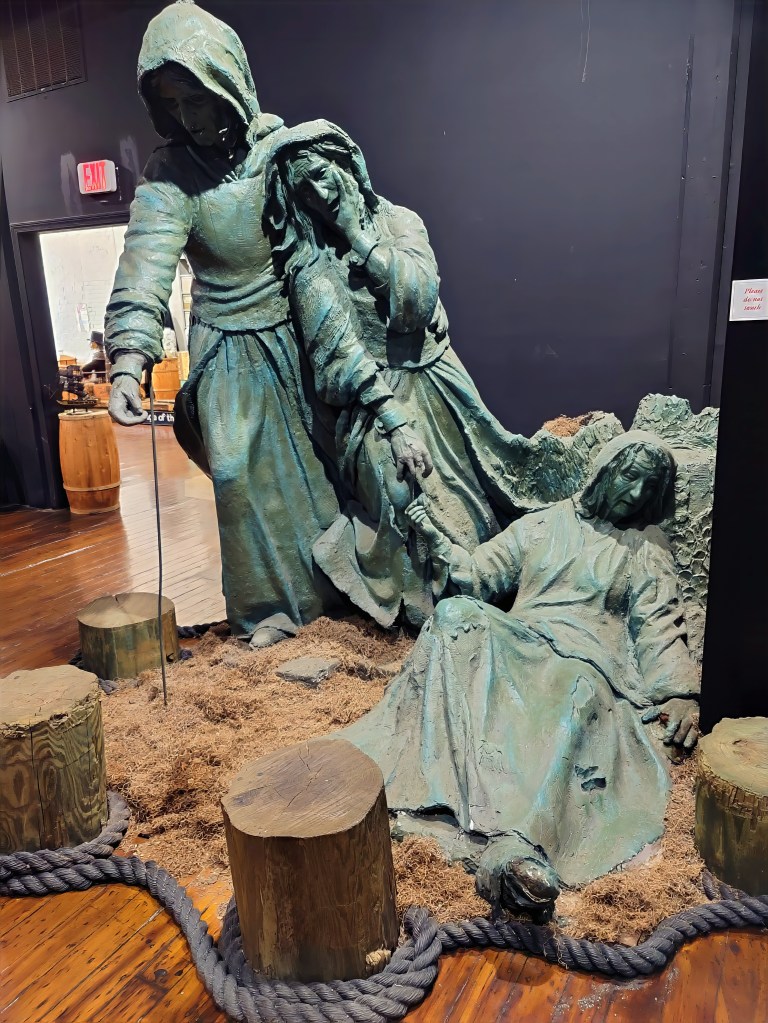
Three Sovereigns for Sarah — Sculpture by Yiannis Stefanakis, Salem, Massachusetts, 1986
This poignant sculpture portrays the three sisters accused of witchcraft during the Salem trials of 1692: Sarah Cloyce, Mary Towne Easty, and Rebecca Nurse, from left to right.
Inspired by the television drama Three Sovereigns for Sarah, the work captures their anguish and enduring sisterly bond. Mary and Rebecca were executed; Sarah survived imprisonment.
More than three centuries separate my life from that of my tenth great-grandmother. Between us stretch generations of births and deaths, marriages and migrations, triumphs and sorrows, and the immense transformations of a nation that did not yet exist when she died. Yet my connection to this history is unusually complex.
Through my own ancestry, I am connected to Mary, the condemned woman whose final petition pleaded for the protection of innocent lives. Through my marriage, I am connected to Sarah, whose sworn accusations formed part of the proceedings that contributed to Mary’s death. I cannot know how much of either woman’s temperament or convictions might have echoed through the generations of our families.
Character is not inherited as simply as the color of one’s eyes or the shape of one’s face. Nor does ancestry confer responsibility for deeds committed centuries before our birth. What it offers is an opportunity to examine the past with greater intimacy.
There is something profoundly moving in knowing that one of my ancestors, facing the certainty of her own death, chose to devote her final appeal to the protection of others.
There is something equally sobering in recognizing that another ancestor, through marriage, participated in the accusations that made such an appeal necessary.
I do not regard this convergence as a reason to assign inherited guilt or inherited virtue. Rather, it is an invitation to consider the moral responsibilities of the living.
We cannot undo the injustices of 1692. But we can refuse to repeat the failures of judgment that made them possible. We can examine evidence before accepting accusations, question authority without surrendering reason, and recognize the humanity of people whose reputations have become convenient targets. Above all, we can choose to cultivate the qualities Mary Towne Easty demonstrated when circumstances offered her every justification for despair.
Her legacy is not defined solely by the injustice she suffered. It is distinguished by the humanity she preserved.
Epilogue: The Witch They Could Not Silence
So, this October, as Halloween approaches and imaginary witches once again populate our decorations, our stories, and our celebrations, I find myself contemplating two women whose lives intersected in the summer of 1692.
Mary Towne Easty and Sarah Vibber.
One accused.
The other an accuser.
Two women living under the same patriarchal institutions, yet occupying profoundly different positions within a judicial tragedy that would forever connect their names. One left behind a petition imploring the authorities to prevent further innocent deaths. The other left behind sworn testimony alleging supernatural injuries that no reliable method of investigation could substantiate. Centuries later, their descendants became connected through marriage, bringing both ancestral histories into the same family. It is an extraordinary convergence, and one that reminds me how intimately the past can inhabit the present.
I do not remember Mary Towne Easty as a witch.
She was not one.
I remember her as something infinitely more remarkable: a woman who retained her humanity when the institutions surrounding her abandoned theirs.
There is a certain poetic justice in the modern celebration of witches. An image once used to stigmatize women has become, for many, a symbol of intelligence, resilience, unconventionality, and feminine independence. Yet the most meaningful tribute to women like Mary is not simply to celebrate the symbolism of their supposed supernatural powers.
It is to defend the actual dignity and freedom of women. To question accusations unsupported by evidence. To challenge prejudice disguised as righteousness. To recognize the humanity of those whom society finds convenient to condemn. And to understand that justice requires courage not only from the accused, but from everyone who witnesses an injustice unfolding.
Because the most terrifying monsters in Salem were not supernatural creatures lurking in the shadows. They were ordinary human beings who allowed fear, prejudice, and misplaced certainty to extinguish their compassion. And the greatest magic in Mary’s story was not magic at all. It was the extraordinary strength of a woman who, despite everything done to her, refused to surrender her conscience.
The men who condemned Mary believed they were purging evil from their community. Instead, they revealed the evil that can emerge when fear masquerades as righteousness. They could imprison her body, disregard her testimony, pronounce her guilt, and place a rope around her neck. But they could not make her guilty. They could not compel her to confess to a falsehood. And they could not prevent posterity from recognizing the injustice they had committed.
That is the enduring triumph of Mary Towne Easty.
Not that she escaped persecution, for she did not. Not that justice prevailed during her lifetime, for it failed her catastrophically. But her integrity survived the institutions that attempted to silence her.
As October’s shadows lengthen and Halloween’s imaginary witches take flight, I offer this remembrance to the very real woman whose life was stolen by the fear of imaginary ones.
May we celebrate the whimsy of witches while remembering the cruelty of witch hunts. May we admire the symbolism of feminine independence while defending the actual freedom of women. And may we never forget that the measure of a civilized society is not how confidently it condemns those it fears, but how faithfully it protects those who stand accused.
My tenth great-grandmother was executed because her society called her a witch.
My husband’s eighth great-grandmother was among those whose accusations helped sustain that society’s terrible delusion.
And today, their descendants share a family, a history, and an opportunity to remember both women with the honesty their stories deserve.
I cannot change what happened between Mary and Sarah. But I can choose what meaning their histories hold for me. I choose to honor conscience over conformity, evidence over accusation, compassion over cruelty, and justice over the seductive certainty of collective fear.
This Halloween, I shall raise a toast not to the witches of imagination, but to the women of history whose courage deserves to be remembered long after the candles have burned down, and the jack-o’-lanterns have gone dark.
To Mary Towne Easty, 1634–1692.
May her memory never be diminished to a costume, her suffering never be mistaken for entertainment, and her courage never be forgotten.
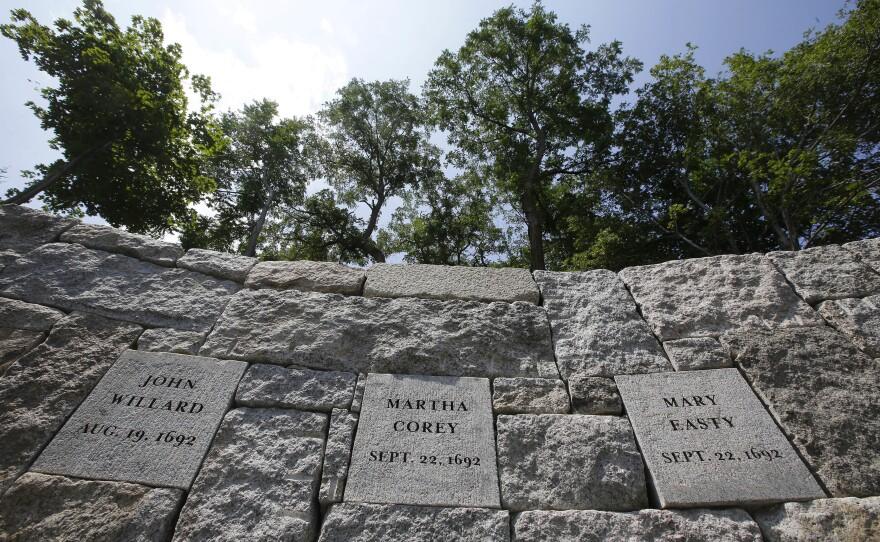
Proctor’s Ledge Memorial — Salem, Massachusetts
Dedicated on July 19, 2017, this solemn memorial, designed by landscape architect Martha Lyon, marks the site where nineteen innocent people were hanged during the Salem witch trials of 1692.
Set within a graceful semicircular stone wall, their engraved names include Mary Towne Easty, executed on September 22, 1692.
Beneath the quiet canopy of trees, these simple stones bear witness to lives unjustly taken, transforming a place of persecution into a sanctuary of remembrance, dignity, and enduring conscience.


Leave a Reply