(1210-1290)
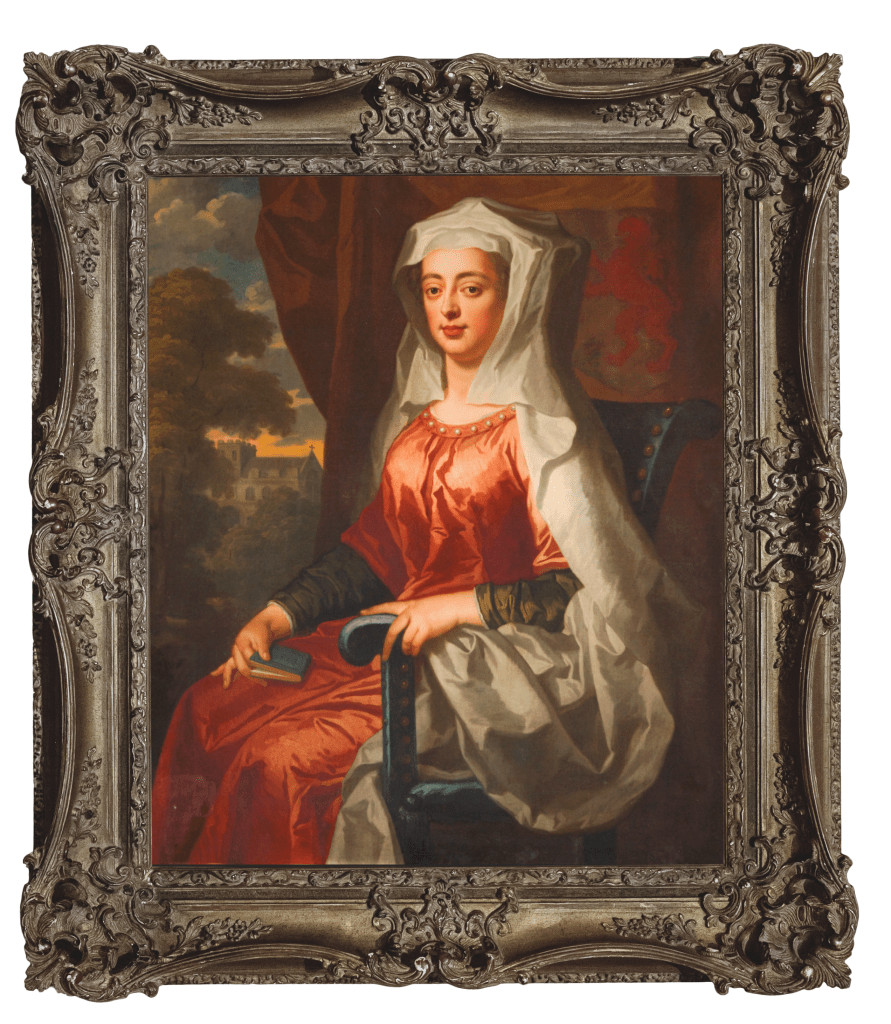
Bàs do-chreidsinneach, gràdh buan.
~ A Gaelic proverb, which means, Death unyielding, love everlasting.
Amidst the rolling green pastures and fathomless lochs of medieval Galloway—where the heather sighs beneath leaden skies and ancient stones murmur the secrets of centuries past—there lived a woman whose spirit blazed with such brilliance that her name, though half-veiled by time, yet echoes through the corridors of history. A woman of singular compassion and immortal renown, whose life would carve a lasting monument into the heart of Scotland and England alike: Dervorguilla of Galloway, Lady of Balliol, my 21st great-grandmother, as traced back though the centuries by way of my paternal grandmother.
Dervorguilla, a Latinate embroidery of the Gaelic Dearbhfhorghaill, meaning “true judgment,” “true testimony,” or “daughter of the oath.” She still gleams in the half-light of the past, a testament to a lineage woven from the old traditions of the Gael and a bridge to the Norman and Saxon legacies reshaping the isles. Dervorguilla was the daughter of ancient kings, heiress, founder of collegiate institutions and abbeys, defender of the downtrodden, lover of books and law, mighty landholder, beacon of strength in a male-dominated world, and—perhaps most poignantly—the heart of one of the most enduring love stories the medieval world has ever known.
The Weaving of Power and Tradition
Quite possibly one of the wealthiest women of her time, Dervorguilla was born around 1210 within the robust gray ramparts of Kenmure Castle, in a land as wild as it was beautiful. She entered a world cloaked in grandeur and destiny.
Her father, Alan, Lord of Galloway, was Constable of Scotland—a man who commanded fleets and armies, a force as untamed as the winds off the Irish Sea. Her mother, Margaret of Huntingdon, bore the blood of royalty, granddaughter to King David I of Scotland, and a conduit between the Celtic past and the Norman present. Through her maternal line, Dervorguilla traced descent from the ancient kings of Alba and the high baronage of England; through her grandmother, Maud of Chester, she was kin to the mighty earls of Chester, and through her aunt Isobel of Huntingdon, she shared blood with Robert the Bruce, who would one day free a kingdom.
Thus, Dervorguilla stood—a living confluence of power, tradition, and destiny—as ancient as the stones of Galloway and as restless as the age into which she was born.
The Role of a Noblewoman in a Turbulent Age
From her earliest days, Dervorguilla was immersed in a world quaking with intrigue and ambition: the ceaseless tension between England and Scotland, the maneuverings of powerful barons, the shifting sands of loyalty and rebellion. In this crucible, where marriages were treaties and heirs the currency of kingdoms, a woman had to be more than beautiful—she had to be astute, unyielding, and quietly formidable.
During the 13th century, the life of a noblewoman was a paradox—outwardly circumscribed by tradition yet teeming with hidden power. Society proclaimed her a vessel, a living covenant: she was to marry well, to bear sons, to preserve the wealth and bloodline of her house. Upon marriage, the ancient law of coverture decreed that her lands and rights passed into the keeping of her husband. Yet beneath the rigid legal veneer, the great ladies of Scotland and England wielded influence that rivaled their male counterparts.
Many noblewomen governed vast estates, negotiated contracts, marshaled troops when necessity demanded, and administered complex financial enterprises. They were guardians of dynasties, defenders of castles, arbiters of marriages, and benefactors of churches and abbeys. In a world where literacy was rare and precious, noblewomen often mastered Latin, French, Scots, Gaelic, and English, languages of law, commerce, and diplomacy.
From their cradles they were trained not only in the gentle arts of embroidery and music, but in the harder disciplines of estate management, letter-writing, arbitration, and patronage. Their reach extended beyond the hearth: they guided the fates of cities, brokered alliances, and in the courts of Europe’s kings, their quiet counsel could shape the destinies of nations.
In Scotland, the Gaelic traditions of tanistry and divided inheritance stood in tension with Norman primogeniture, and as a result, women like Dervorguilla could inherit vast tracts of land. They were not mere pawns, they were power incarnate, sought after for their influence and feared for their ability to command loyalty and fortune. Religious patronage, too, became a sacred instrument of authority: by founding abbeys and endowing churches, a noblewoman not only secured prayers for her soul but cemented her family’s name in the eternal ledger of history.
Thus, chroniclers of the age may have recorded women’s names only in relation to their fathers or husbands, but the truth was richer and deeper. Women like Dervorguilla were the hidden architects of kingdoms, the silent builders of enduring legacies.
A Union of Love and Legacy
At the age of ten, Dervorguilla entered the royal court, a living testament to her house’s ambition. By thirteen, she was married to John de Balliol, a young Anglo-Norman lord whose domains stretched from the rugged dales of northern England to the far fields of Picardy in northern France. His blood was Norman and French; his wealth, considerable; his pedigree, unassailable. Together, Dervorguilla and John de Balliol presided over a realm sprawling from the Scottish Highlands to the green heart of England, and even across the Channel into France and Flanders—a tapestry of land and loyalty unmatched by their peers.
Their marriage, born of politics, blossomed into genuine love—a love that would endure beyond death.
In 1234, Dervorguilla’s father died without a legitimate son, and by the customs of Gaelic law, his vast holdings were divided among his daughters, Dervorguilla, Helen, and Christiana. In the years that followed, death thinned her family’s ranks, and Dervorguilla’s wealth grew yet greater. Through inheritance, she acquired lands in Galloway, Cunninghame, Lauderdale, and Huntingdon, vast estates that dwarfed even her husband’s holdings.
Yet she was no mere figurehead. Dervorguilla managed her properties with acumen and intelligence, overseeing tenants, resolving disputes, and financing religious and educational endeavors. She was patroness to monks, benefactress of the poor, and a guardian of learning in a darkened age. Through her wisdom and resources, John de Balliol rose to become a key advisor to King Henry III of England and the protector of young King Alexander III of Scotland. John de Balliol fought on King Henry III’s behalf during the Second Barons’ War and, though captured at the Battle of Lewes in 1264, survived the turbulent years with reputation and influence largely intact.
The Founding of Balliol College
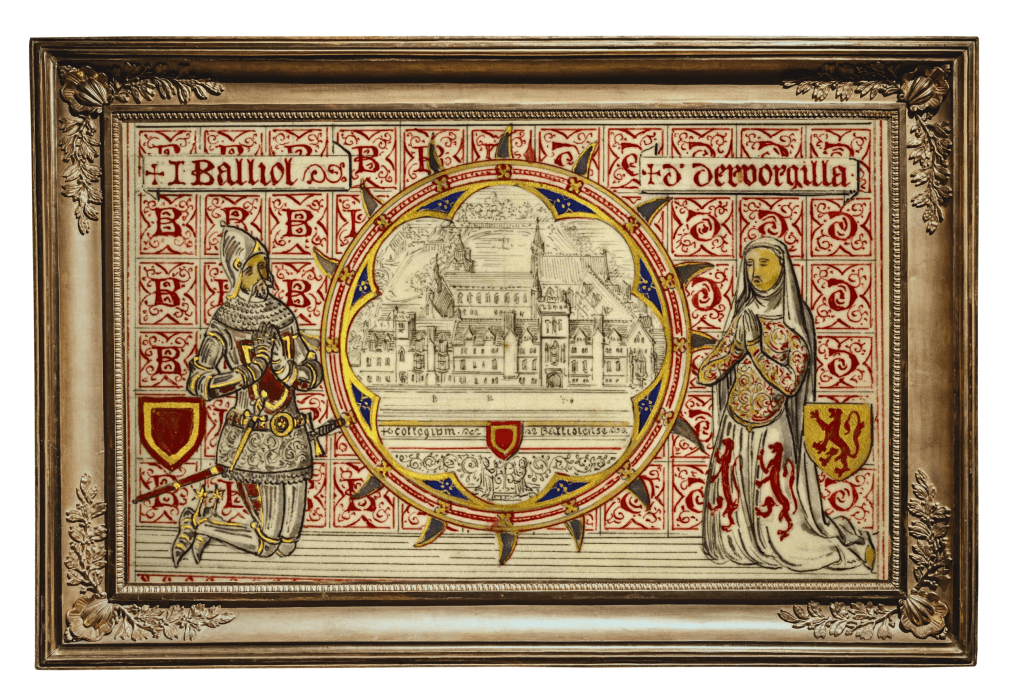
When John found himself enmeshed in a bitter dispute with Walter Kirkham, Bishop of Durham, in 1263, he agreed as penance to found an almshouse in Oxford for impoverished scholars. But it was Dervorguilla who transformed this modest beginning into permanence. After John’s death in 1268, she endowed the foundation, secured its statutes and privileges, and thereby forged Balliol College—an institution that would educate kings, philosophers, and poets for centuries to come. To this day, the Dervorguilla Society of Balliol College stands as a living tribute to her.
A Keeper of Manuscripts and Memory
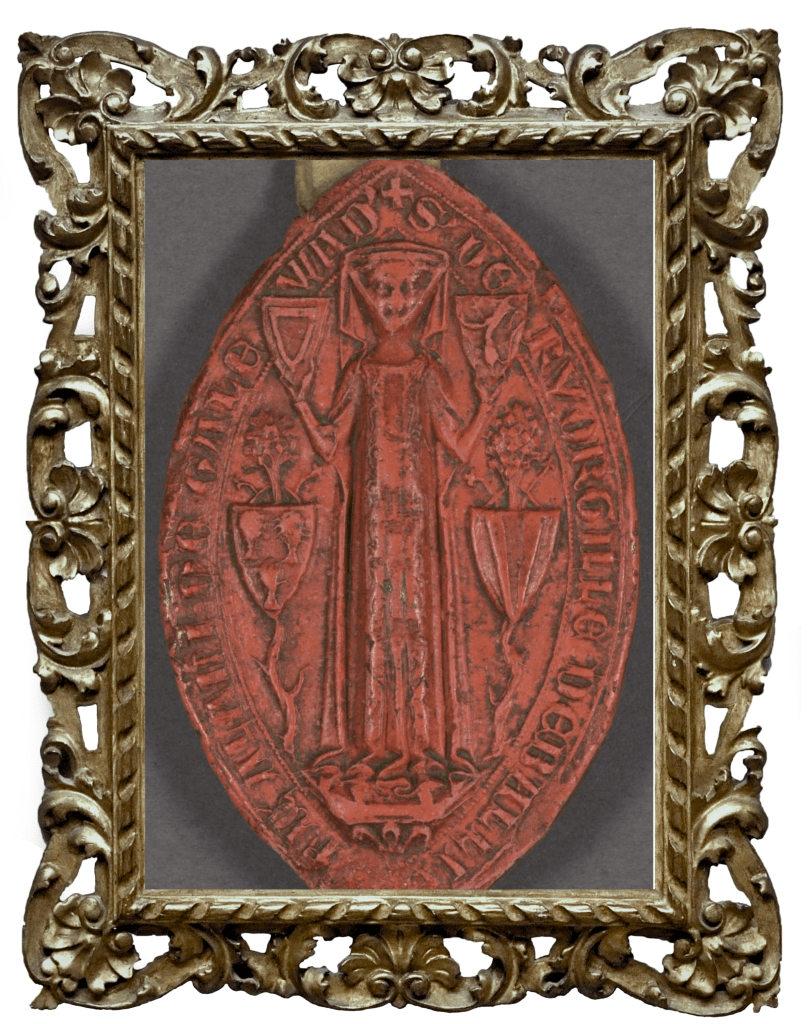
Through the reverent custodianship of the monks of Sweetheart Abbey, the intellectual legacy of Dervorguilla of Galloway also endures—not only etched into the solemn stones of the abbey she founded, but preserved in the delicate, timeworn pages she once held in her own hands. She was not merely the abbey’s foundress but its first and most luminous patron of learning, bequeathing from her private collection a treasury of manuscripts—sacred vessels of knowledge wrought in an age when the written word was rarer than gold and revered as a bond between the temporal and the timeless.
These manuscripts, fragile yet resilient, open a rare portal into the cultivated mind of a thirteenth-century noblewoman, revealing not just literacy but deliberate curation: Dervorguilla as steward of memory, guardian of wisdom, protector of the sacred craft of writing itself. In an era when books were painstakingly hand-copied upon vellum, bound with meticulous care, and venerated as objects of spiritual and intellectual power, her library stands as a testament to a mind attuned to both devotion and inquiry. In an age when literacy itself was a form of power, especially for women, Dervorguilla’s library illuminated her exceptional stature.
Her collection reached far beyond the familiar Books of Hours beloved for private devotion; it embraced the greater canon of Christendom’s intellectual heritage. Among her prized volumes were the Dialogues of Gregory the Great—a cornerstone of ecclesiastical thought—and the Sweetheart Bible, a magnificent four-volume testament crafted in the late thirteenth century, now safeguarded within the Robert Garrett Collection at Princeton University.
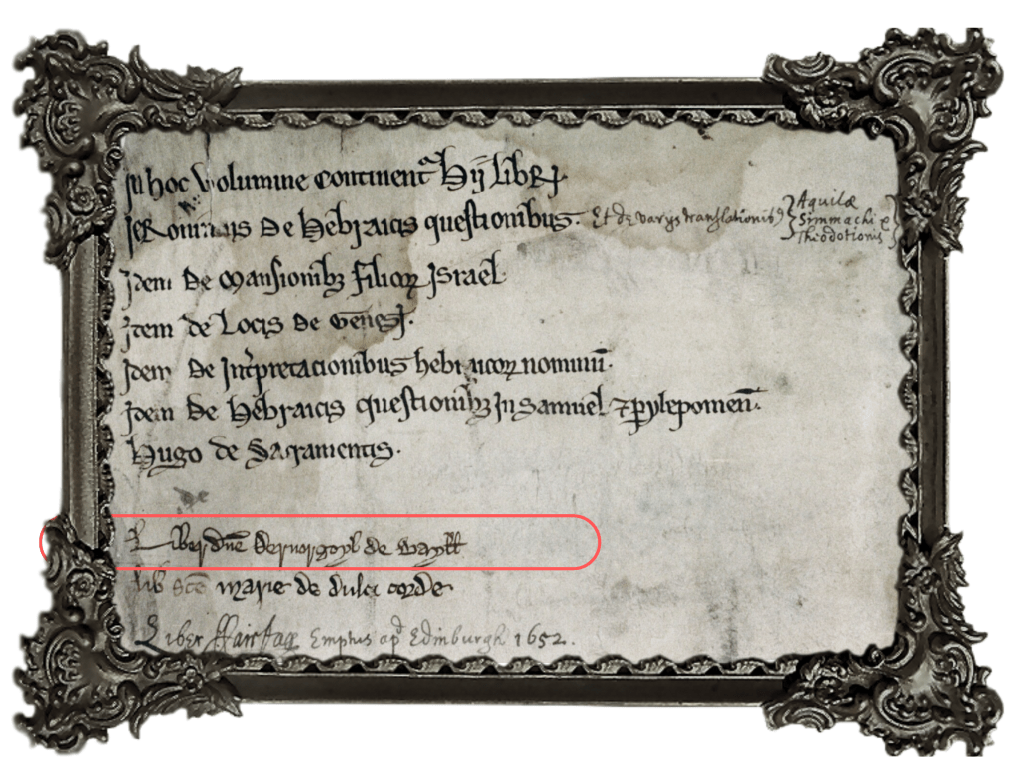
Among her treasures was also the Sweetheart Psalter—a manuscript now vanished into the mists of history. Once known to have belonged to Withom of Kirkconnell in 1889, it last surfaced in the halls of Sotheby’s in 1950 before slipping beyond recorded sight—a ghost of a lost inheritance. Perhaps most extraordinary among her known volumes is MS Fairfax 5, a twelfth-century English manuscript preserved in the Bodleian Library at Oxford. Within its venerable pages are five treatises of Jerome—the great translator of Scripture—and one by Hugh of St. Victor, master theologian of the medieval world. Inscribed upon its margins is: Liber d[omi]n[a]e Dervorgoyl de Bayl[io]l— “The Book of Lady Dervorguilla of Balliol.”
That inscription, delicate yet enduring, is more than mere provenance; it is a whisper across seven centuries—a tangible link to a woman who, amid an age of wars and shifting kingdoms, gathered words as others gathered jewels. For Dervorguilla, these manuscripts were not mere possessions, but sanctuaries of thought and tradition—vessels of faith, learning, and memory. Through the ink of scribes and the prayers of monks, through vellum leaves and cloistered study, Dervorguilla’s spirit endures incandescent, unbowed, and eternal—a guardian of wisdom, a mother of learning, her legacy cradled in the living heart of Sweetheart Abbey.
The Fruit of Her Lineage
Dervorguilla was not merely the custodian of estates and legacies; she was also the mother to ten children, one of whom would be crowned king—John Balliol of Scotland—and grandmother to another ruler, Edward Balliol, whose fortunes would rise and fall like the tides amidst the ceaseless turmoil of Scotland’s wars for sovereignty. Most of her children would marry into the foremost families of England and Scotland, extending her lineage like a great tree across the kingdoms. Had Dervorguilla lived but a few more years, she herself—granddaughter of King David I—might have stood among the foremost claimants to the Scottish throne, her bloodline as ancient and uncontested as any.
She did not live long enough to see her youngest and only surviving son ascend to the forefront of Scotland’s succession crisis, crowned by the hopes of a kingdom and the heavy hand of English influence. John Balliol was crowned King of Scotland in 1292. He was widely disliked and mockingly known as Toom Tabard—Empty Shirt—for his feckless obedience to Edward I of England, a docility Dervorguilla herself would never have displayed. Yet, by the grace of fate or the mercy of providence, she was spared the bitter sight of his downfall: the relentless undermining by Edward I, the humiliating abdication of 1296, the fracturing of Scotland’s fragile independence, and the cruel forfeiture of her ancestral estates to the encroaching English crown. John Balliol spent his final years in quiet exile in France. In her lifetime, Dervorguilla bore witness to promise and ascendancy; in death, she was shielded from the sorrowful eclipse of all she had built and bequeathed.
Bridges and Cloisters: A Life of Public Devotion
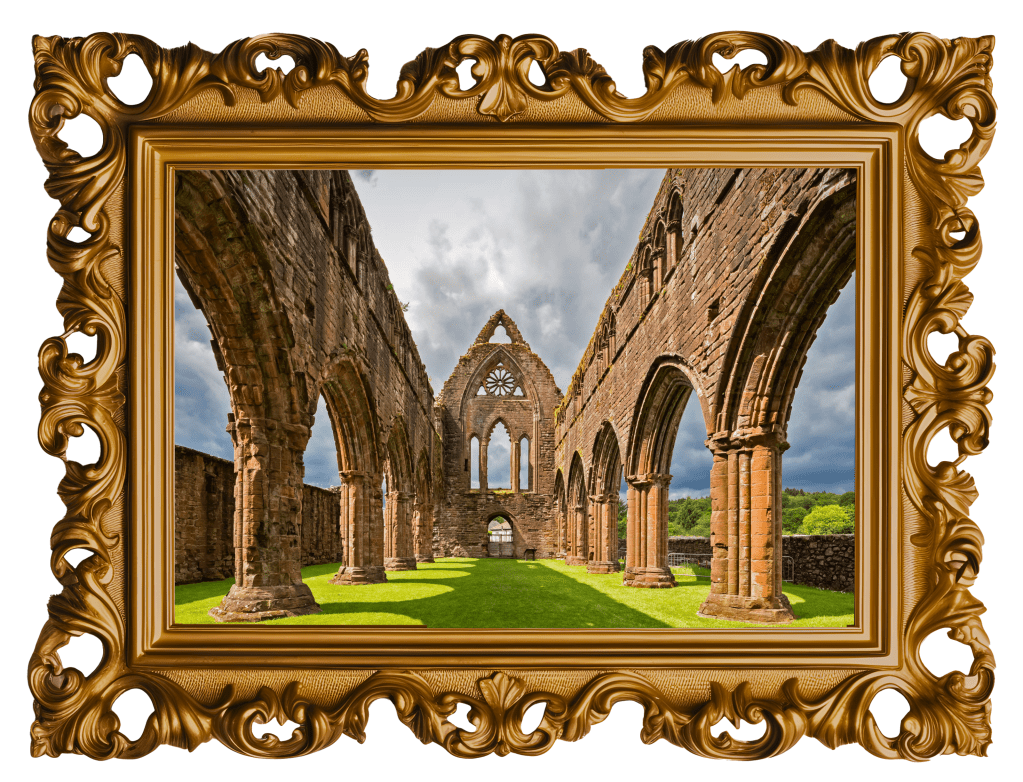
For forty-six years, Dervorguilla and John de Balliol walked side by side through triumphs and sorrows—in the council chambers of kings, across windswept battlefields, and within the quiet courtyards of their many manors. When John died in October 1268, Dervorguilla’s grief was boundless, but her love found expression in immortal acts. In Galloway, she founded New Abbey—a Cistercian sister house to Dundrennan Abbey—built not only for the glory of God but as a sacred monument to her husband’s memory. The ruins of its red sandstone walls, wrought in the clean, austere lines of Early Gothic architecture, rise still from the earth.
In the ancient town of Dumfries, where the River Nith winds its restless course toward the Solway Firth, there stands a bridge—a span of stone arching with quiet grace across the waters—known as Dervorguilla’s Bridge. Though the present structure, raised in the seventeenth century, bears the marks of later ages, it holds the name of a far older crossing, one that local tradition credits to Dervorguilla herself. In the 1230s, she is said to have commissioned a bridge to bind the banks of the Nith—a gesture of charity and vision, providing safe passage for pilgrims, merchants, and travelers. Though the bridge of her day was likely wrought of timber and long claimed by the river’s ceaseless tides, its memory endures, a testament to her far-reaching influence.
Yet Dervorguilla’s devotion to the public good did not end with roads and crossings. In Dumfries, she established a house for the Friars Minor—the Franciscans, barefoot disciples of poverty and humility—securing a haven for their ministry amid the growing town. Further along the winding roads of Galloway, in Wigtown, she founded a house of Black Friars—the Dominicans, warriors of the pulpit, preachers of doctrine. Not content with sowing the seeds of faith in the southwest alone, she extended her patronage northward to Dundee, where she established a Franciscan friary, nurturing the spiritual life of that bustling port.
Through these foundations—of bridges both literal and spiritual—Dervorguilla left more than stone and mortar; she left a living testament to a life spent in service to the soul of her nation. Her acts, humble and grand alike, ripple still through the mists of Scottish history, as enduring as the rivers she once spanned and the prayers, she helped send rising from cloister and chapel into the gray northern skies.
Dervorguilla as Caritas Incarnate
Beyond her enduring renown as a patroness of learning, Dervorguilla of Galloway stood as a living embodiment of caritas—that highest and most sacred form of Christian love, selfless and unwavering. In an age often darkened by cruelty and strife, she became a beacon of mercy, her compassion extending far beyond the walls of her abbeys and colleges.
Across the length and breadth of Scotland, Dervorguilla founded almshouses for the poor, hospitals for the infirm, and sanctuaries for the weary, institutions where the broken might find solace and the forgotten, dignity. These acts were not fleeting gestures of noblesse oblige, nor charity for appearance’s sake; they were deliberate and enduring testaments to her profound belief that wealth and station carried with them a divine onus to serve.
In Dervorguilla’s hands, stewardship was not only a burden of duty, but a sacred trust—a visible expression of the Christian ideal that the truest lordship lay not in dominion, but in care for the least among one’s people. Through her quiet and ceaseless acts of mercy, she transformed Christian charity from an abstract virtue into a living force, stitching her name into the hearts of those she served and into the very fabric of a nation’s memory. In her life, as in her legacy, she was more than a lady of lands and titles; she was a testament to caritas made flesh—staunch, resplendent, and lasting.
A Final Act of Devotion
Her life, woven from threads of compassion and duty, culminated in a final act of devotion that bound the earthly and the eternal, love and legacy, in a gesture as profound as it was emblematic of her age.
Following the medieval belief that the heart was the vessel of the soul—the sacred seat of love, valor, and memory—Dervorguilla engaged in a deed steeped in the deepest symbolism of her age. In an act that spoke with the eloquence of both devotion and tradition, she had the heart of her beloved John de Balliol carefully removed, embalmed with fragrant balms and spices, and sealed against the decay of time. This was no simple preservation, but an intricate ritual—a reverent alchemy of adoration and absence. She encased his heart in a reliquary of the finest ivory, richly adorned with enameled silver, crafted by artisans who practiced the laborious medieval art of fusing powdered glass onto metal, creating luminous, jewel-like embellishments intended to defy the centuries.
That ivory box, with its gleaming silver tracery and sacred cargo, became her constant companion. At her dining table, a place of honor was always set before it; wherever she journeyed—from the misty hills of Galloway to the bustling courts of London, from the porticos of Durham to the sanctity of abbey cloisters—the heart of John de Balliol traveled with her. Through the winding halls of her estates, it was carried at her side; in her private chambers, it rested as a silent sentinel of her enduring adoration.
For twenty-two years, Dervorguilla carried John’s heart—a pilgrim, not to some distant shrine, but to the monument of memory and devotion she bore tenderly in her own hands. In an age where marriages so often served as transactions of power and property, her fidelity blazed as a rare and incandescent fire—a testimony to a love so ardent that even death could not sever its bond. And when her own life ebbed away in the chill of January 1290, she left explicit instructions: she was to be laid to rest at New Abbey, the sacred house she had raised in John de Balliol’s memory, with the ivory casket of John’s embalmed heart clasped to her breast, so that even in death they would remain eternally entwined.
The Silent Stones and the Echo of Love
In homage to her extraordinary and ceaseless loyalty, the monks of New Abbey gave their foundation a new name—Dulce Cor, Sweetheart Abbey—a lasting invocation of the tenderness and constancy that had made Dervorguilla’s life and loss immortal. Though battered by the tempests of war, the iconoclasm of Reformation, and the slow erosion of time, the red sandstone ruins of Sweetheart Abbey still endure— a witness to faithfulness unfading. Beneath the fading light of twilight, the weathered stones often flush with a rosy glow, as if still warmed by the embers of Dervorguilla’s undying love.
The original stone effigy that once lay upon her tomb was lost to history’s restless tides, but in 1932, a new likeness was wrought—Dervorguilla, serene and steadfast, forever clutching to her chest the ivory casket that cradled John’s heart. Through her, the whisper of antiquity finds voice once more, and amid the silent stones of Sweetheart Abbey, one can almost hear—faint but unbroken—the steady, immortal pulse of her abiding affection.
The Queen Who Might Have Been
On September 26, 1290, the fragile hopes of Scotland were plunged into disarray. Margaret, the Maid of Norway—sole, surviving heir to the Scottish crown—perished at sea on her voyage to claim the throne, a child queen who never touched the soil of her inheritance. Her death, shrouded in sorrow and mist, left a kingdom adrift, poised on the edge of civil war. For two harrowing years, Scotland teetered, leaderless and uncertain, while great houses gathered like storm clouds, each with a claim upon the vacant crown.
To stave off the chaos of national strife, the guardians of Scotland turned to Edward I of England—the iron-willed monarch known to history as the Hammer of the Scots—to arbitrate among the claimants. Of all those who pressed their bloodlines forward, the fiercest rivalry lay between the House of Bruce and the House of Balliol—two ancient lines tracing descent from kings of old. After deliberation, Edward I cast his judgment in favor of John Balliol, the only surviving son of Dervorguilla of Galloway and John de Balliol.
It is a bitter twist of history that Dervorguilla, granddaughter of King David I, had died but months earlier, on January 28, 1290. Had she lived, her lineage, wealth, and formidable influence might have made her a claimant in her own right—a queen not by marriage or motherhood, but by the ancient blood of kings flowing unbroken through her veins.
Beneath the Stones, Beyond the Stars: Dervorguilla’s Lasting Light
The story of Dervorguilla of Galloway and John de Balliol—my 21st great-grandparents—is not merely recorded in brittle parchments and dim genealogies. It lives on within the vestiges of Sweetheart Abbey, in the statutes of Balliol College, and in the blood that courses through my own veins. It is a legacy of devotion, strength, and the eternal power of love—a story that unites the past to the present in an unbroken chain of memory, as prevailing as the remnants of Dulce Cor and as far-reaching as the stars.
And so, through the slow unspooling of centuries—as empires crumble to dust and time forgets—her legacy endures, not as a mere shadow, but as a radiant testament: a muse to poets and chroniclers, her story inked into the annals of love and sovereignty, and her name carried beyond even the confines of the Earth, bestowed upon a distant crater on the veiled face of Venus.
Dervorguilla—daughter of oath, mother of kings, keeper of love immortal.
 Westerhoff Ancestry
Leave a comment