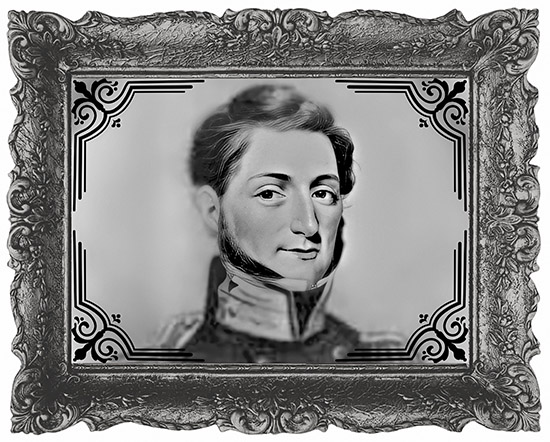
Forbes Britton as a young second lieutenant in the 7th Regiment of Infantry.
Forbes N. Britton, Jr. was my second cousin five times removed through my paternal grandmother.
Renowned for his wit, humor, eloquence, and a sense of adventure, Forbes N. Britton, Jr. was born in 1812 in Clarksburg, Virginia. It is surmised that he attended Kenyon College in Ohio before being appointed to the United States Military Academy at West Point.
Graduating from West Point in 1834, Britton was assigned to the 7th Regiment of Infantry and stationed at Fort Gibson in Indian Territory, which is now located in Muskogee County, Oklahoma. It was at Fort Gibson where Britton formed a lifelong friendship with fellow army officer, Daniel P. Whiting. Together, they served in various conflicts, including the Seminole War in Florida and the Mexican War in Corpus Christi.
Britton’s lighthearted nature, quirky antics, and rebellious spirit are revealed in Whiting’s various accounts of him in his journal entries. Whiting shares a story that when Britton was ordered to take charge as quartermaster at Fort Fanning in Florida, he was given such overly belabored instructions by his superior, Captain Dusenbury, which seemed to overlook the fact that Britton was an experienced officer of proven judgment.
Whiting wrote that Britton entered his room one day and began to pull out of his pocket several large horse flies. Whiting asked what he was doing with them in his pocket. “I caught them,” said Britton, “from the backs of government oxen and I intend to send them to Capt. Dusenbury to show him my zeal in the public service.”
In another account Whiting documented a softer side of Forbes N. Britton, Jr. Despite Britton’s duty to oversee the relocation of the Seminole people to Indian Territory, he could not ignore their immense sadness at being forced to leave their ancestral lands. In a gesture of compassion, Britton began collecting pine knots from the surrounding forests. He carefully packed boxes filled with the fragrant wood, knowing how much the Seminoles cherished the scent and the significance of the pine knots. One by one, he handed out the knots to each woman, man, and child, offering them a small piece of home to carry with them on their journey. Despite his efforts to bring solace to the Seminoles, Britton could not shake the heavy weight of sorrow that lingered in his heart. He knew that no amount of pine knots could truly ease the pain of displacement and loss that the Seminoles were collectively experiencing.
Forbes N. Britton, Jr. was a dashing young officer stationed at Fort Gibson when he first laid eyes on the enchanting and beautiful Rebecca Millard. Their love blossomed quickly, and on March 13, 1836, they became husband and wife. In 1838, while Britton served at Fort Coffee, Elizabeth gave birth to twins, a boy and a girl. Britton was overjoyed and immediately wrote to his friend Whiting at Fort Gibson to share the happy news.
As Whiting related, the announcement came extravagantly delivered “in a letter enclosed in a double envelope, stamped with two seals, addressed and written throughout with a pen that made double marks and was signed twice with his name in full. [Britton] proclaimed that since birth of the twins he could do nothing except in doublets, took two bites to one before at his lunch and two drinks of his toddy when one had sufficed in previous conviviality. He could not account for the twins except that, as quartermaster, his vouchers had to be submitted in duplicate.”
When Britton visited Fort Gibson some months later “he entered the garrison from the steamboat landing, with a baby on each arm and a parasol in each hand.”
Forbes N. Britton, Jr. was a man of many talents and occupations after his military service. He had a knack for business and a drive for success that led him to great prosperity in his new ventures. After resigning his military commission on July 16, 1850, Britton moved to Corpus Christi, Texas with his family. Initially planning to establish a law practice and invest in real estate, he quickly found success in the shipping and mercantile business with partners William Mann and John Baskin. Their exportation of animal hides, skins, and wool brought in substantial profits. Britton also thrived in his grocery/commission business with Cornelius Cahill and in his ownership of a sheep ranch near New Braunfels. His entrepreneurial spirit led him to various other ventures, including lobbying for a road between Corpus Christi and El Paso, incorporating the Western Artesian Well Company, and forming the Texas Western Railroad Company, although the company laid no tracks.
A beacon of hope and unity in the tumultuous times of the mid-19th century, Forbes N. Britton, Jr. was elected as a state senator from 1857 to 1860 for the Nueces district in the seventh and eighth Texas legislatures. Britton was famous for his moderate views and unwavering support for Governor Sam Houston. As a personal emissary to Governor Houston, Britton sought peace and relief from the civil strife that plagued the area. Despite facing opposition, Britton remained steadfast in his beliefs. He delivered powerful speeches advocating for artesian wells in the arid plains of South Texas and articulately spoke out against secession.
Forbes N. Britton, Jr. had always been a pillar of strength and determination. As he made his way to Austin for the special session of the Texas legislature, it was evident that his health was deteriorating. Governor Houston had called for this special session to address the proposal of Texas seceding from the Union, a weighty issue that consumed Britton’s thoughts. Despite his failing health, Britton was resolute in his commitment to represent his constituents and to fight to keep Texas united with the Union. Tragically, Britton succumbed to pneumonia on February 14, 1861, at the age of forty-nine. The news of Britton’s passing spread quickly, leaving a somber cloud over the Texas legislature.
The Corpus Christi Ranchero on February 23, 1861, reported the death of Forbes N. Britton, Jr. in Austin. The paper noted that the “coffin, a box of red cedar, was sealed with zinc and on the silver name plate was engraved: ‘Hon. Forbes Britton. Died February 14, 1861’.”
Forbes N. Britton, Jr. was laid to rest at the Texas State Cemetery in downtown Austin, becoming the third person to receive such an honor.
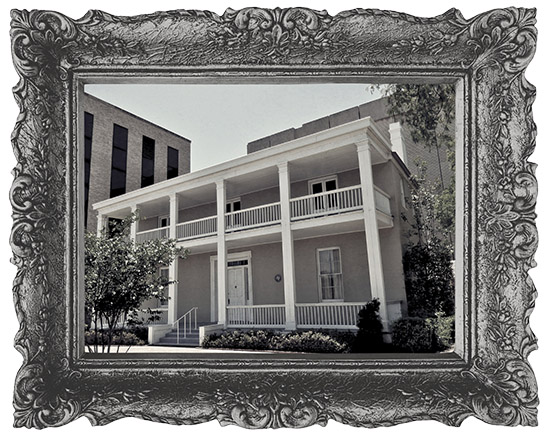
Centennial House
Standing proudly on South Bluff overlooking Corpus Christi Bay, the historic home of Centennial House has been a symbol of strength and resilience in the face of countless storms for almost 175 years. Built by Forbes N. Britton, Jr. in 1849, the classical Greek revival structure, which is the oldest building in Corpus Christi has weathered hurricanes, wars, and the passage of time with grace and dignity.
Centennial House has been a place of refuge for many during the periodic storms that have battered the city, providing safety and shelter when it was needed most. To ensure that the home would endure turbulent weather, Centennial House’s construction is decidedly solid. Its exterior walls are eighteen inches thick and are fashioned out of large blocks of shellcrete. Shellcrete is a composite building material comprised of lime, oyster shell, water, and sand, and surfaced with a scored, light plaster finish.
Following Forbes N. Britton, Jr.’s passing in 1861, Centennial House took on a new role as a hospital for Confederate soldiers during the Civil War. Over the years, Centennial House passed through the hands of four different families until George Evans, who would later become mayor of Corpus Christi, purchased it in 1880. The Evans family made significant improvements to the house, preserving its historical significance. In 1936, the Southern Mineral Company took over the building, utilizing it as their headquarters. During the 1950s, the house was leased as an office for the highway department during the 4-year construction of Harbor Bridge.
In 1965, the Corpus Christi Area Heritage Society recognized the historical significance of Centennial House and purchased it with the intention of turning the building into a museum. During renovations to restore the abode to its former glory, fascinating artifacts were suddenly exposed, including a 100-year-old horse bone and remnants of bottles and chinaware. A hidden sliding door was also discovered, adding to the intrigue of the house’s history. After receiving a state historic medallion dedication, Centennial House officially opened its doors as a museum in 1969, offering tours to the public. A significant on-site archeological dig in 1988 uncovered evidence that the property had once been a 2,000-year-old Native American garbage dump, adding another layer to the house’s storied past.
Today, Centennial House stands as a testament to the enduring history of Corpus Christi and the legacy of those who had previously walked through its halls, individuals like Forbes N. Britton, Jr.
 Westerhoff Ancestry
Leave a comment